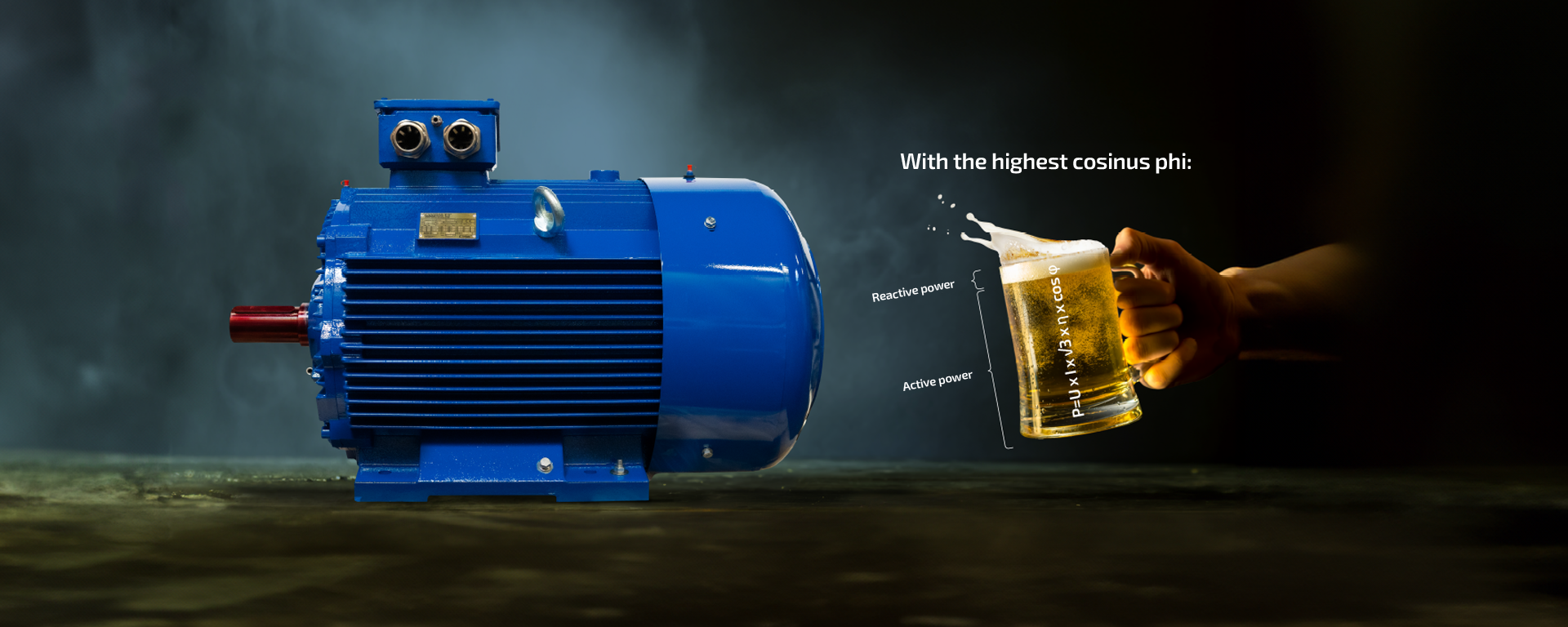
“Cos what?” asked one of Kolmer’s employees when a valued customer brought up the subject. The customer explained that Cantoni motors had the highest cos phi (ϕ) of all motors.
Cos phi (ϕ) in electric motors indicates how effectively the motor uses electricity. It is the ratio between the electricity the motor actually uses and the total electricity it receives.
A higher cos phi means a more efficient motor and therefore lower energy costs. This factor is often explained using a glass of beer.
Picture a glass of beer. You pay for the whole glass, but you do not drink the foam—that represents reactive power. The clear, golden liquid is what you are after: active power.
Back to cos phi, also known as power factor. Every electric motor brand talks about the efficiency of its motors. There are even legal requirements governing it. This makes sense: a motor with high efficiency saves energy and money. But a high cos phi means less wasted electricity and lower costs too.
In other words, you want a motor with high values for both to save energy and operate efficiently.
And that is precisely where the difference lies. Nowadays, every motor brand offers high efficiency. But no other motor brand has a cos phi as high as that of Cantoni electric motors.
High efficiency combined with less wasted electricity delivers substantial savings, especially when you consider that electricity accounts for around 95% of an electric motor’s total lifetime costs. So our customer was absolutely right.
Cheers to the exceptional power of electric motors from Poland’s Cantoni Motor.
An electric motor’s efficiency and cos phi (power factor), considered together, provide an important measure of its performance. Below is an explanation of both terms and how they relate to each other.
The efficiency of an electric motor is the ratio between the useful power it delivers (output) and the power it draws from the electricity supply (input). It indicates how well the motor converts electrical energy into useful energy, such as driving a machine, and is expressed as a percentage.
If a motor uses 100 units of electricity and delivers 90 units of useful energy, its efficiency is 90%.
η = (P-out / P-in) × 100%
Where:
Cos phi (cos ϕ), or power factor, is the ratio between real power (active power) and apparent power in an alternating current circuit. It indicates how efficiently a motor uses electricity. It is the ratio between the real power, which does the work, and the total power the motor draws, including wasted energy.
cos ϕ = Pactive / S
Where:
The Relationship Between Efficiency and Cos Phi in an Electric Motor
If a motor has high efficiency, it wastes little energy when converting electricity into motion. If its cos phi is high, the motor makes efficient use of the electricity it draws, with little waste due to reactive power.
Suppose you have an electric motor that:
The motor’s efficiency is:
Efficiency = (50 / 60) × 100% = 83.33%
The motor’s cos phi is:
cos ϕ = 50 / 70 = 0.714
This means that the motor converts 83.33% of the electricity into useful energy and efficiently uses 71.4% of the electricity it draws.
Both values are therefore included in the formula for calculating an electric motor’s effective power:
P = U × I × √3 × η × cos ϕ
Where: